If you’re wondering how to start investing for retirement but have no idea where to begin, you’re not alone.
Maybe you’ve built up some extra savings and you’re ready to put that money to work. Or maybe saving has been difficult and retirement feels like something you’ll worry about later.
Either way, understanding your retirement investing options is a great place to start.
Retirement accounts like a Traditional IRA, Roth IRA, and 401(k) can help you save and invest for your future while offering valuable tax benefits. But with different account types, tax rules, contribution limits, investment options, and providers to choose from, figuring out where to start can feel overwhelming.
In this guide, I’m going to break down the basics of retirement investing, including how Traditional IRAs, Roth IRAs, and 401(k)s work, how they’re taxed, how much you may need to save, what these plans can cost, and where you can open one.
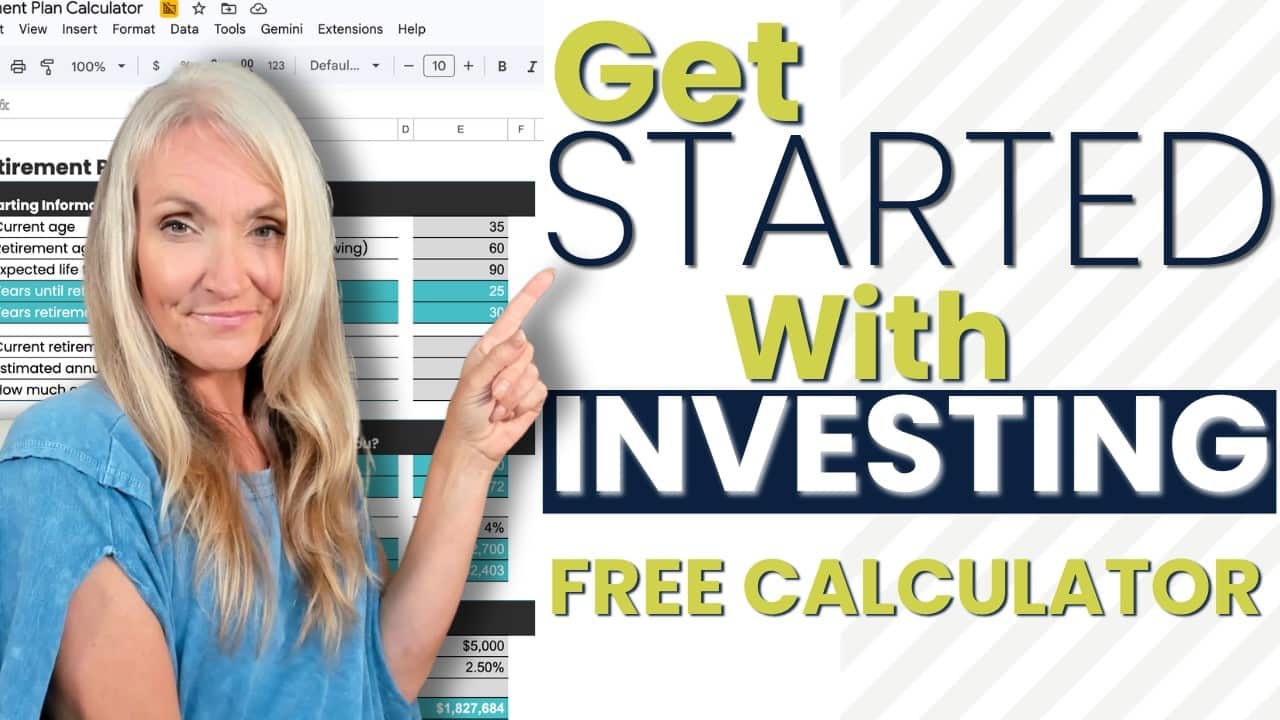
We’ll also look at my free retirement planning calculator so you can see how much your savings could potentially grow over time and how much you may need to contribute to reach your retirement goals.
You can also watch the full video breakdown here:
Table of Contents
- Do I Really Need a Retirement Plan?
- What Is a Retirement Plan and How Does It Work?
- Traditional IRA vs. Roth IRA vs. 401(k): What’s the Difference?
- What Retirement Plans Are Available for Self-Employed People and Business Owners?
- How Much Can You Contribute to an IRA in 2026?
- How Much Do You Need to Save for Retirement?
- How Much Do Retirement Plans Cost?
- Where Can You Open a Retirement Account?
- Ready to Start Planning for Retirement?
- FAQs
- About the Author
Do I Really Need a Retirement Plan?
If you already have extra money sitting in savings, retirement can be a great place to start putting some of that money to work.
A common recommendation is to first have around 6 to 12 months of savings available for emergencies. That gives you a financial cushion so you’re less likely to need money that you’ve already invested for retirement.
Once you have money beyond that, you can start thinking about where to invest the extra.
But this is also where you need to be careful.
There are a lot of different ways to invest your money, and they can come with different levels of risk, potential return, fees, and expenses. There are things like scams, Ponzi schemes, and investment accounts with fees or hidden fees that can catch you off guard.
That’s why it’s important to understand what you’re investing in and not just rely on someone telling you what you want to hear.
I also like thinking about investments in different buckets. Some may carry more risk and more potential return, while others may be lower risk. The important thing is understanding that every investment carries some level of risk and being intentional about where you put your money.
If someone makes an investment sound like an easy way to get rich or promises an amazing return, be cautious.
Is Saving for Retirement Really Worth It?
Even if you don’t have a huge amount of money to invest right now, I still think it’s worth learning about your retirement options and getting into the habit of saving.
Saving is a habit. Having a retirement account set up can make it easier to start contributing whenever you do have a little extra money available.
I like to think of retirement savings as a “never touch” account. There are situations where you can access the money, but the goal is to leave it invested for the long term and give it time to grow.
That time matters because your money has the opportunity to earn returns, and then those earnings can potentially generate additional earnings over time.
That’s the power of compounding, and later I’ll show you what that can look like using the retirement planning calculator.
So once you’re ready to start putting money aside for retirement, the next question is where that money actually goes and how it gets invested.
That starts with understanding what a retirement plan is and how it works.
What Is a Retirement Plan and How Does It Work?
A retirement account gives you a place to save and invest money for the future, but the account itself is not the investment.
Think of the retirement account as the container that holds your investments. A Traditional IRA, Roth IRA, or 401(k) is the type of account, while the stocks, funds, or other assets you choose inside it are what your money is actually invested in.
Many retirement accounts allow you to invest through the stock market, including investments tied to publicly traded companies. These are companies whose shares can be bought and sold by investors, and the people who own those shares are the company’s shareholders.
You’ve probably heard of places like the New York Stock Exchange. That’s one example of where publicly traded stocks are bought and sold.
You can invest by buying individual stocks, but you can also invest in groups of stocks or funds that hold investments across certain industries or types of businesses.
This distinction is important because simply opening a retirement account doesn’t automatically determine how much risk you’re taking or how much your money will earn. That depends largely on the investments you choose inside the account.
What Are the Benefits of a Retirement Account?
Once you understand that the account itself is separate from the investments inside it, the next question is: why use a retirement account at all?
One of the biggest reasons is the tax advantages.
The government provides certain tax benefits for retirement accounts to encourage people to save for their own future. The idea is to give you an incentive to build up money that can help cover your expenses later in life.
Depending on the type of account you choose, you may receive a tax benefit today or potentially receive tax advantages when you withdraw the money later.
Retirement accounts also give your money the opportunity to grow over time while it stays invested. The value can go up or down depending on the investments you choose, so returns are never guaranteed. But the longer your money remains invested, the more time it has to potentially benefit from compound growth.
That combination of tax advantages and long-term growth potential is one of the main reasons retirement accounts are commonly used as part of a long-term retirement strategy.
But the tax treatment isn’t the same for every account.
That’s where the differences between a Traditional IRA, Roth IRA, and 401(k) start to matter.
Traditional IRA vs. Roth IRA vs. 401(k): What’s the Difference?
Once you decide you’re ready to start investing for retirement, one of the biggest questions is which type of account should you use?
A Traditional IRA, Roth IRA, and 401(k) can all help you save and invest for retirement, but they work differently when it comes to taxes, contribution limits, employer involvement, and who can open the account.
Here’s a quick comparison before we break each one down:
| Feature | Traditional IRA | Roth IRA | 401(k) |
|---|---|---|---|
| Who opens it? | You | You | Usually through an employer |
| Tax treatment | Potential tax deduction now; taxed when withdrawn | Contributions are made after tax; qualified withdrawals can be tax-free | Depends on whether the plan uses Traditional or Roth treatment |
| Employer involved? | No | No | Usually yes |
| Employer match? | No | No | May be offered |
| Contribution limits | IRA limits apply | Shares the IRA limit with Traditional IRA | Separate from IRA limits |
What is a Traditional IRA?
A Traditional IRA is an individual retirement account that you can open on your own, so it does not have to be connected to an employer.
One of the main benefits is the potential for a tax deduction today. Depending on your income and whether you or your spouse are covered by a retirement plan at work, some or all of your contribution may be deductible.
Your money can then stay invested and grow tax-deferred, which means you generally do not pay taxes on the investment growth each year while the money remains in the account. Instead, you generally pay taxes when you withdraw the money later.
So the basic idea is:
Potential tax benefit now → invest and grow tax-deferred →
pay taxes when you withdraw later
And even if your income is too high to receive the deduction, that does not necessarily mean you can’t contribute to a Traditional IRA. We’ll get into those deduction rules in the 2026 income-limit section.
But a Roth IRA flips that tax treatment around.
What is a Roth IRA?
A Roth IRA is also an individual retirement account that you can open on your own.
With a Roth IRA, you contribute money that has already been taxed, so you generally do not receive a tax deduction for the contribution today.
The benefit comes later. Your money can grow inside the account, and qualified withdrawals in retirement can be tax-free if the requirements are met.
Here’s the easiest way to think about it:
Pay taxes now → invest for retirement →
qualified withdrawals can be tax-free later
This is one reason I often like Roth accounts for most people who are just getting started, although whether it makes sense for you depends on your income, tax situation, and retirement goals.
There are also income limits that can affect whether you can contribute directly to a Roth IRA, which we’ll cover when we get into the 2026 rules.
Traditional and Roth IRAs are accounts you open yourself. A 401(k), on the other hand, usually comes through your job.
What is a 401(k)?
A 401(k) is a retirement plan that you typically get through your employer.
If your employer offers one, you can contribute part of your paycheck directly into the plan. Some employers may also contribute through an employer match, depending on the terms of the plan.
Within a workplace retirement plan, you may also have the option to choose between Traditional and Roth treatment. So when you see the word “Roth,” it doesn’t always mean Roth IRA—you can also have a Roth 401(k).
If you’re self-employed or own a business, you may also be able to set up a 401(k) or other retirement plans such as a SEP, SIMPLE, or Safe Harbor plan, depending on your business and the applicable rules.
And you don’t necessarily have to choose between an IRA and a workplace or business retirement plan. You can have both an individual IRA and a plan through your employer or business.
That’s one reason I generally like starting with an IRA when you’re just getting started. It’s one of the simpler options to understand and set up, and having one doesn’t prevent you from also investing through work or your business later.
What Retirement Plans Are Available for Self-Employed People and Business Owners?
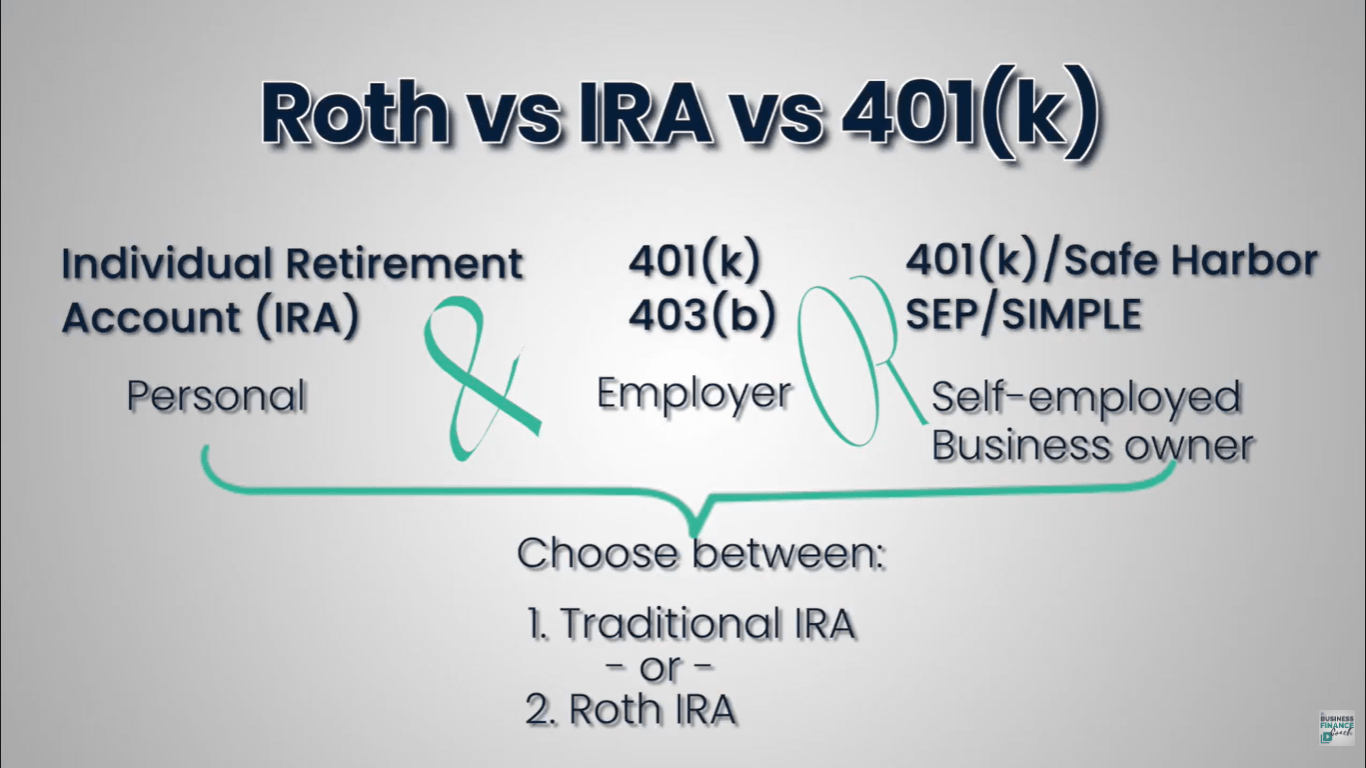
If you’re self-employed or own a business, you may have additional retirement plan options beyond a Traditional IRA, Roth IRA, or regular workplace 401(k).
Some of the plans you may come across include:
- SEP IRA – A retirement plan that can be used by self-employed individuals and business owners. Contributions are generally made by the employer or business.
- SIMPLE IRA – A retirement plan designed for smaller businesses that allows both employee salary contributions and employer contributions.
- Safe Harbor 401(k) – A type of 401(k) plan that follows certain contribution and plan-design rules that can make it easier for businesses to meet specific retirement plan requirements.
- Traditional 401(k) – A 401(k) plan where contributions are generally made before tax, with taxes typically paid when the money is withdrawn later.
These plans can offer higher contribution opportunities than an IRA, but they can also come with more rules, setup requirements, and administrative responsibilities.
If you’re just getting started, I generally like to keep things simple. An IRA can be one of the easier retirement accounts to understand and open, and you can explore other business retirement plan options as your needs change.
And once you know which type of account you may want to use, the next question is usually:
How much are you actually allowed to contribute?
That brings us to the 2026 contribution limits and income rules.
How Much Can You Contribute to an IRA in 2026?
For 2026, the contribution limit for Traditional and Roth IRAs is shared, which means you don’t get a separate full contribution limit for each account.
Age | 2026 IRA Contribution Limit |
|---|---|
Under age 50 | $7,500 |
Age 50 and older | $8,600 |
So if you have both a Traditional IRA and a Roth IRA, you don’t get a separate full limit for each one. The annual limit is shared between the two accounts.
For example, the $7,500 annual limit works out to about $625 per month when divided across 12 months.
But the annual contribution limit is only one part of the rules.
Your income can also affect how much you’re allowed to contribute directly to a Roth IRA and whether a Traditional IRA contribution is tax-deductible.
Are There Income Limits for a Roth IRA?
Yes. Your income can affect whether you’re allowed to contribute directly to a Roth IRA and how much you can contribute.
For 2026, Roth IRA contributions begin to phase out once your modified adjusted gross income (MAGI) reaches the lower end of the applicable range. As your income moves through that range, the amount you’re allowed to contribute is gradually reduced.
Filing Status | Contribution Starts to Phase Out | No Direct Roth IRA Contribution At |
|---|---|---|
Single / Head of Household | $153,000 | $168,000 |
Married Filing Jointly | $242,000 | $252,000 |
These are the 2026 Roth IRA phaseout ranges published by the IRS.
Once your income reaches the upper end of the range, you can no longer make a direct Roth IRA contribution for that year.
Traditional IRAs follow a different set of rules, especially when it comes to whether your contribution is tax-deductible.
How Do Income Limits Affect a Traditional IRA Deduction?
A Traditional IRA works differently from a Roth IRA because you can still contribute even if your income is higher. The bigger question is whether that contribution will still be tax-deductible.
If you have a retirement plan at work, the deduction is phased out as your income increases. There’s no deduction above about:
- $91,000 for single filers
- $149,000 for married filing jointly
If you are married filing jointly and don't have a workplace retirement plan, but your spouse does, your Traditional IRA tax deduction starts phasing out at $242,000 of modified AGI. Once your modified AGI reaches $252,000, the deduction is completely phased out.
And if your income is too high to contribute directly to a Roth IRA, you may also hear about a backdoor Roth, where you contribute to a Traditional IRA and then move that money into a Roth IRA.
So before deciding how much to contribute, it’s important to look at both the annual contribution limits and the income rules that apply to your situation.
But those limits only tell you how much you’re allowed to put into the account. They don’t tell you how much you may actually need for retirement.
So instead of relying on one generic retirement number, let’s look at how to estimate what you may need and how much you may want to contribute each month.
How Much Do You Need to Save for Retirement?
There isn’t one retirement number that works for everyone.
How much you need depends on things like:
- current age
- when you want to retire
- how long you expect retirement to last
- how much you already have saved
- how much income you want each month in retirement
That’s why I like using a retirement calculator instead of relying on one generic savings target. It lets you plug in your own numbers and see how those assumptions affect your retirement projection.
The calculator works in three parts: first, you enter your starting information; next, you see what your contributions could grow to; and finally, you can work backward from the monthly income you want in retirement.
What Information Do You Need to Enter?
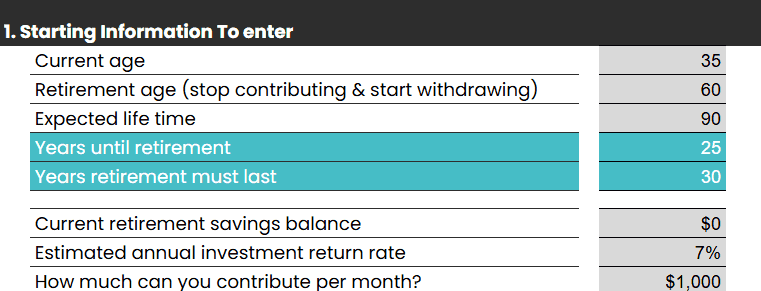
The first section is where you enter the information the calculator needs to build your retirement projection.
In this example, we’re starting at age 35 and planning to retire at 60, which gives us 25 years until retirement.
We’re also using an expected lifetime of 90, so we’re planning for about 30 years in retirement.
For current retirement savings, we’re starting with $0.
For the estimated annual investment return, we’re using 7% as the planning assumption in this example.
Then we enter a $1,000 monthly contribution to see how that amount could potentially grow over the 25 years leading up to retirement.
These numbers give us the starting point for the calculation and let us see what that money could potentially grow to over time.
How Much Could Your Contributions Grow?
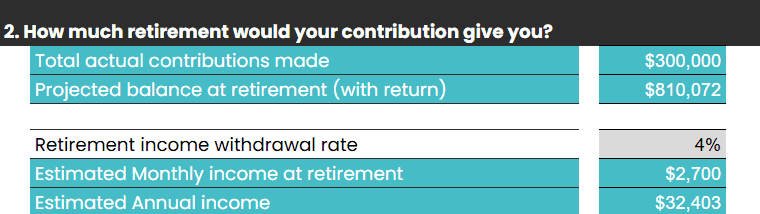
Based on the starting information above, contributing $1,000 per month for 25 years would add up to $300,000 in total contributions.
But this is where things start to get interesting.
Using the 7% estimated annual return in this example, the calculator projects that the account could grow to around $810,072 by retirement.
So even though the actual contributions total $300,000, the projected balance is much higher because the money has had time to stay invested and compound.
To estimate how much income that balance could provide in retirement, the calculator uses a 4% withdrawal rate.
With that assumption, the projected balance would provide about $2,700 per month, or roughly $32,403 per year, in estimated retirement income.
This is why time matters so much. The longer your money has to stay invested, the more opportunity it has to potentially grow and build on previous returns.
How Much Do You Need to Contribute to Reach Your Retirement Goal?
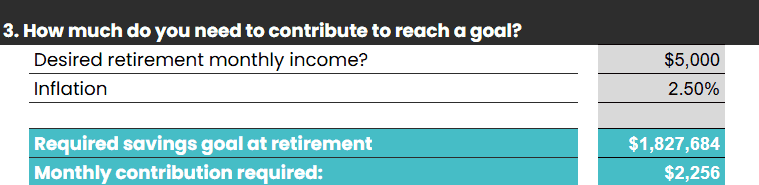
The third section looks at retirement planning from the other direction.
Instead of starting with how much you’re contributing now, we start with the monthly income you want in retirement.
In this example, we’re aiming for $5,000 per month in retirement income and using 2.5% for inflation.
Based on those assumptions, the calculator estimates that we would need about $1,827,684 saved for retirement.
To work toward that goal from the starting point above, the calculator estimates a required contribution of about $2,256 per month.
This is why I like looking at retirement planning both ways. You can see what your current contributions may grow into, but you can also start with the income you want later and work backward to see what you may need to save now.
Ready to Run Your Own Retirement Numbers?
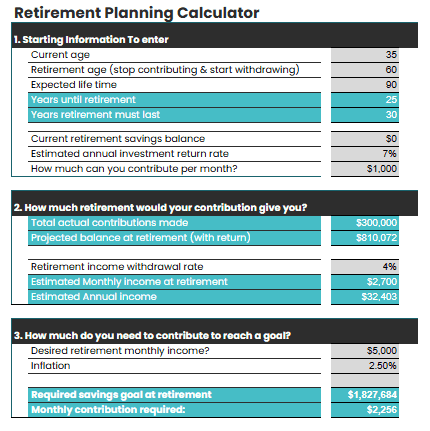
Now that you’ve seen how the calculator works, you can plug in your own retirement timeline, savings, monthly contributions, and income goal to see what your numbers could look like.
Use my free Retirement Planning Calculator to estimate how much your retirement savings could grow and how much you may need to contribute to work toward the retirement income you want.
Get the Free Retirement Planning Calculator Here
Once you have your own numbers in front of you, it also helps to have a quick way to translate a monthly retirement income goal into a rough savings target.
What Is the $1,000-a-Month Rule for Retirement?
A simple way to estimate it is that for every $1,000 per month you want in retirement income, you may need around $250,000 invested, based on a 4% withdrawal assumption.
So if you’re trying to picture what your retirement goal might look like, here’s a quick way to estimate it:
| Monthly Retirement Income | Approximate Amount Invested |
|---|---|
| $1,000/month | $250,000 |
| $2,000/month | $500,000 |
| $3,000/month | $750,000 |
| $5,000/month | $1.25 million |
This gives you a quick way to connect the monthly income you want in retirement with the amount you may need invested.
And remember, time and compounding matter too. In the calculator example, contributing $1,000 per month over 25 years gives those contributions time to potentially grow well beyond the amount you actually put in.
Using that same estimate, you can also get a quick idea of how much you may need invested for more specific retirement income goals.
How Much Do You Need in a 401(k) to Get $3,000 a Month?
Using the same $1,000-a-month rule, about $3,000 per month in retirement income would roughly point to around $750,000 invested.
That estimate is based on the same 4% withdrawal assumption used in the calculator.
It’s a simple way to connect a monthly retirement income goal with the amount you may need to invest, but it’s still just a planning estimate rather than a guaranteed outcome.
How Much Do Retirement Plans Cost?
The cost of a retirement plan can vary depending on where you open the account and what you invest in.
In many cases, you can open an IRA with no account-opening fee, but that doesn’t always mean the account will be completely free.
Some of the costs you may come across include:
- account maintenance fees
- investment expense ratios
- robo-advisor fees
- financial advisor or wealth management fees
- transfer or account closure fees
For example, some online brokerages may offer $0 account opening and $0 maintenance fees, while certain investments inside the account may still charge their own expenses.
The important thing is to look at both the cost of the retirement account itself and the cost of the investments or services you choose inside it.
A small percentage fee may not seem like much at first, but over time, it can make a meaningful difference as your account balance grows.
Where Can You Open a Retirement Account?
If you’re wondering where to set up an IRA, there are several types of companies that can hold and administer your retirement account.
These can include:
- banks and credit unions
- brokerage firms, such as Fidelity, Charles Schwab, or Vanguard
- insurance companies
- financial advisors or wealth management firms
- robo-advisors, such as Betterment, Robinhood, or Wealthfront
The company that holds and administers your retirement account is called the custodian.
Where you open the account can also affect the investment options, fees, and services available to you.
And if you decide later that you want to use a different provider, you may also be able to transfer the account to another custodian.
What Is a Retirement Plan Custodian?
A custodian is the company or financial institution that holds and administers your retirement account.
So when you open an IRA through a bank, brokerage, insurance company, financial advisor, or robo-advisor, that provider may act as the custodian of the account.
The investments available inside your IRA or 401(k) can depend on what your custodian offers.
And choosing one provider doesn’t necessarily mean you’re stuck there forever. You can transfer your retirement account to another custodian later if you decide to change providers.
What Happens After You Open the Account?
Once your retirement account is open, the next step is choosing what you want the money inside the account to be invested in.
The investment options available to you can depend on what your custodian offers. That may include individual investments or funds that hold groups of investments.
This goes back to the distinction we talked about earlier: your IRA or 401(k) is the account, while the investments you choose inside it are what give your money the opportunity to grow over time.
You don’t have to understand every investment option before you get started. The important thing is knowing what type of account you’re opening, where it’s being held, and what you’re actually investing in.
Before you move forward, the main thing to remember is that retirement planning comes down to understanding what type of account you’re using, how it’s taxed, how much you can contribute, what you’re invested in, and what your own retirement numbers may look like over time.
You don’t need to figure out everything at once. The goal is to understand the basics first, then use your own timeline, savings, and income goals to guide your next steps.
Ready to Start Planning for Retirement?
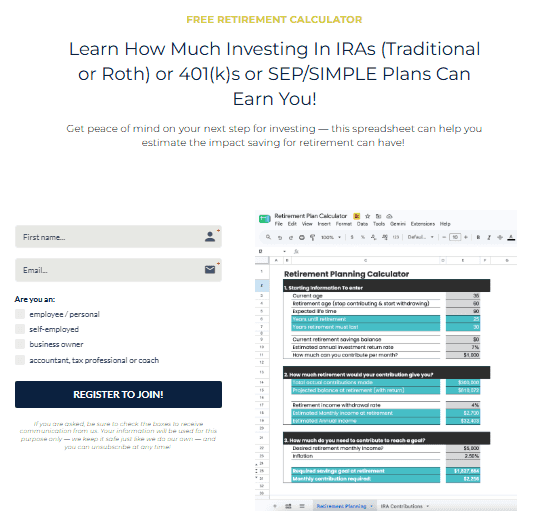
The first step is understanding the different types of retirement accounts, how the tax rules work, how much you may be able to contribute, and what your long-term numbers could look like.
Once you have that foundation, you can start making decisions based on your own goals, timeline, and financial situation.
And if you want to see what your numbers could look like, use my free Retirement Planning Calculator to estimate how much your retirement savings could potentially grow and how much you may need to contribute to work toward the retirement income you want.
Access the Free Retirement Planning Calculator Here!
FAQs
Can I Set Up My Own Retirement Plan?
Yes. You can open an individual retirement account, such as a Traditional IRA or Roth IRA, on your own through a provider that offers retirement accounts.
You don’t need an employer to open an IRA, which is one reason I like it as a simpler place to start if you’re just beginning to invest for retirement. You can also have an IRA in addition to a retirement plan through your employer or business.
Is It Better to Have a 401(k) or an IRA?
You don’t necessarily have to choose between the two.
A 401(k) is typically offered through an employer, while an IRA is an account you can open on your own. You can have both an IRA and a workplace or business retirement plan.
If you’re just getting started, I generally like an IRA as a simpler place to begin, and having one doesn’t prevent you from also investing through a 401(k) later.
What Are the Three Main Types of Retirement Accounts?
The three account types we focused on here are a Traditional IRA, Roth IRA, and 401(k).
Traditional and Roth IRAs are individual retirement accounts you can open yourself, while a 401(k) is typically connected to an employer. There are also other retirement plans available for business owners and self-employed individuals, including SEP, SIMPLE, and Safe Harbor plans.
Can You Have Both an IRA and a 401(k)?
Yes. You can have an IRA and a workplace or business retirement plan at the same time.
So opening a Traditional IRA or Roth IRA does not necessarily prevent you from also contributing through a 401(k) or another retirement plan available through your employer or business.
What Is the Difference Between a Traditional IRA and a Roth IRA?
The main difference is when you receive the tax benefit.
A Traditional IRA may give you a tax deduction today, depending on your income and whether you or your spouse are covered by a retirement plan at work. The money then grows tax-deferred, and withdrawals are generally taxed later.
With a Roth IRA, you contribute money that has already been taxed, so you generally do not receive a deduction today. In return, qualified withdrawals can be tax-free later.
About the Author
Hi there, 
Background in public accounting, teaching courses in higher education and specializing in small business coaching, services and education. I'm Amanda!
Your Instructor | The Business Finance Coach
I've spent my career in accounting, tax, finance, and education—from working at PwC and KPMG to teaching accounting and taxes at colleges and universities, and creating educational content for companies including Intuit TurboTax.
Throughout that experience, I kept seeing the same problem: small business owners were hugely underserved.
They were overwhelmed by complicated accounting software, confused by conflicting advice, and often left feeling like this was a hopeless area of their business that they would never understand.
I knew there had to be a simpler way.
So I took what I'd learned from accounting firms, education, and working with real businesses, and created The Business Finance Coach and The Master Your Accounting & Taxes Program.
My goal is to make business finances simple, practical, and understandable—so you can confidently manage your business, keep more of what you earn, and focus on building the business you actually want.